Since 2008 — Trusted by 500,000+ Analyses
The TRITON Method —
A Complete Reef Care System
The TRITON Method is a complete reef care system combining ICP-OES water analysis, personalised dosing, and standardised biological filtration. A truly holistic and synergistic approach, unmatched in its benefits — no water changes required.
The reef keeping problem nobody talks about
Stop Chasing Numbers. Start Knowing.
You test your water. The numbers look fine. But something's off — corals aren't growing, colours are fading, and every forum gives different advice.
The problem isn't your dedication. It's that standard tests show you 5% of the picture and leave you guessing about the rest.
The TRITON Method shows you the full picture — 45 parameters, parts-per-billion precision, and specific guidance for your tank. No guesswork. No conflicting advice.
Testing blind spots
Home kits test 5–8 parameters. Your reef depends on 45. The gaps are where problems hide.
Conflicting advice
Forums say one thing, your LFS says another. Without data, every opinion sounds equally valid.
Slow decline
Parameters look stable, but trace elements drift invisibly. By the time you see the problem, weeks have passed.
The Dosing–Water Change Loop
Dose blindly, hope it's right, then water change to stop invisible accumulation, and dose again. No testing and continued dosing means your reefkeeping success is left to chance.
A holistic reef care system — since 2008
How the TRITON Method Works
Unlike conventional approaches that rely on patchwork solutions, the TRITON Method integrates two components into one system: standardised filtration and tailored supplementation. This combination eliminates trade-offs — and makes water changes unnecessary.
Standardised Filtration
A defined 3-chamber sump — algae refugium, protein skimmer with granular media, and return pump — creates a predictable, consistent filtration environment. Because TRITON knows exactly what your filter does, every variable is accounted for.
See the sump designTailored Supplementation
Core7 Flex Base Elements provides more than the foundation — calcium, alkalinity, magnesium, and essential trace elements in one balanced system. It also includes INFUSION, a balanced micronutrient source for your refugium that dramatically enhances filtration and compensates for what the standardised filter removes from the system. This approach creates a baseline, makes frequent water changes largely unnecessary, and allows ICP testing every 2–3 months to reveal exactly what your corals need. The standardised filter ensures these results are uniquely actionable.
Core7 Flex Base ElementsTogether, these two pillars form a closed loop — no guesswork, no trade-offs, no water changes.
The Foundation: A Standardised 3-Chamber Sump
The TRITON Method is built on a specific filtration design — three chambers working in sequence to create a balanced, self-sustaining ecosystem.
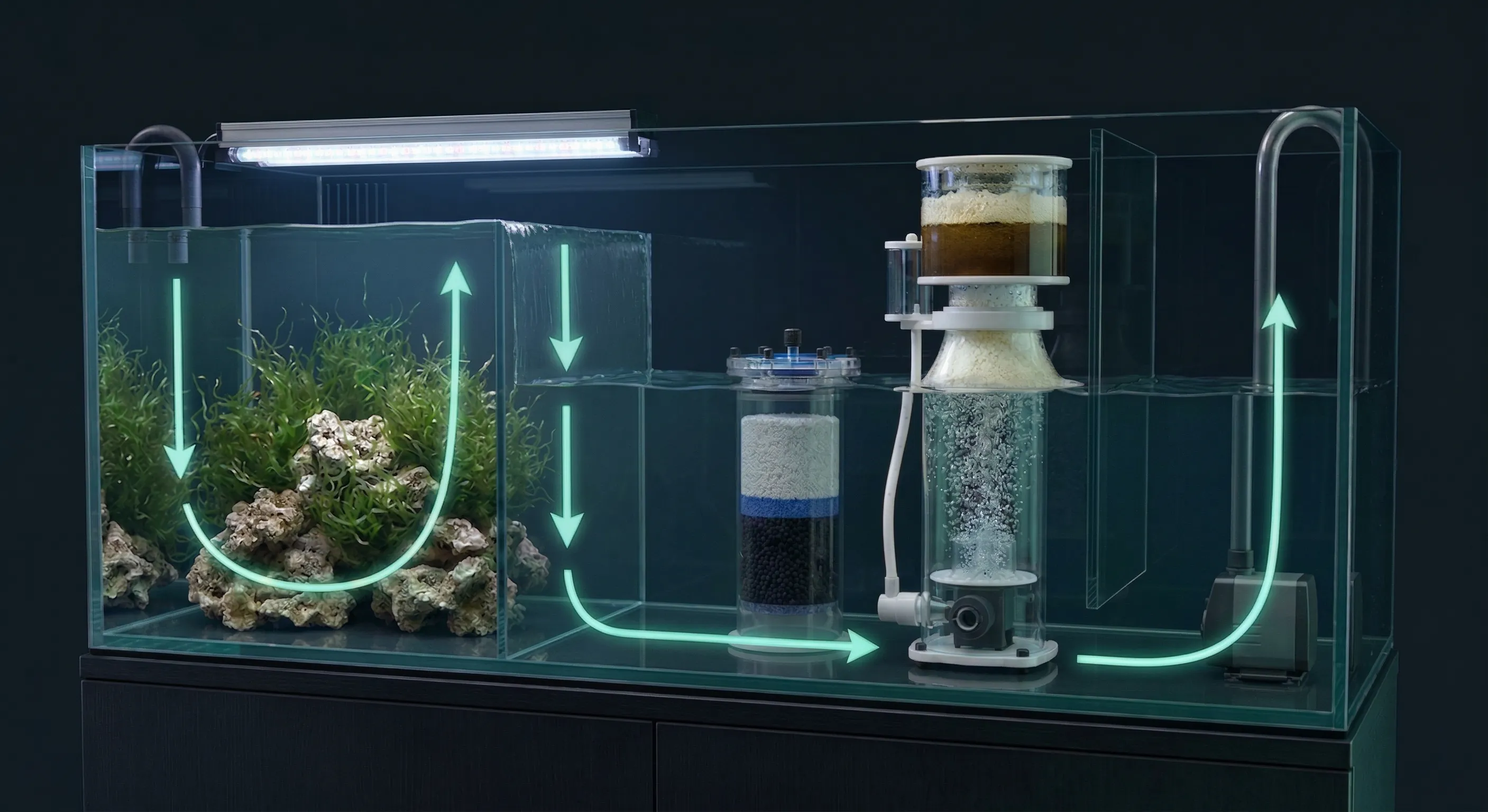
- Chamber 1 — Algae Refugium Macroalgae under T5 lighting export nutrients naturally, stabilise pH, and produce plankton that feeds your corals. The heart of the method.
- Chamber 2 — Skimmer & Granular Media Protein skimmer for organic waste export, plus granular media — activated carbon and phosphate remover (GFO) — for consistent water clarity and stability. No filter socks needed.
- Chamber 3 — Return Pump Rated at 10× your display tank volume. Clean, balanced water returns to your display — the high throughput allows algae to work far more efficiently, creating a single, homogenous body of water throughout your system.
The ongoing cycle
Test. Understand. Dose. Repeat.
Once your filtration is set up, the TRITON Method becomes a simple, repeating cycle.
Test Your Water With ICP-OES
Collect a water sample and mail it to one of our 5 labs worldwide. Inductively Coupled Plasma Optical Emission Spectrometry (ICP-OES) analysis measures 45 parameters at parts-per-billion precision — revealing what home test kits cannot see.
Learn about ICP testingUnderstand Your Results
Receive personalised recommendations based on 500,000+ analyses and your reef's habitat type — not generic charts, but specific guidance for your tank. You'll know exactly what's depleted, what's elevated, and what your reef needs.
See a sample analysisCore7 Flex
Core7 Flex is TRITON's all-in-one base element system — it delivers calcium, alkalinity, magnesium, key elements, and INFUSION custom elements for your refugium in a single, balanced solution. Adjust with MYTE for personalised trace element fine-tuning based on your results. Then monitor, re-test in 2–3 months, and repeat.
Core7 Flex — the dosing foundationCore7 Flex
The all-in-one base element system. Doses Calcium, Alkalinity, Magnesium, and essential elements in one solution — the dosing foundation of the TRITON Method.
Core7 Flex product pageMYTE
Optional but powerful. MYTE converts your ICP results into two custom-blended supplement bottles — 15 individual trace elements, adjusted to your reef's exact needs.
MYTE product pageThe question everyone asks
No Water Changes — How and Why It Works
The TRITON Method eliminates water changes by controlling every variable in the system. The standardised filtration — algae refugium for nutrient export, protein skimmer for organic removal, and granular media for phosphate control — handles what traditional reef keeping delegates to dilution. Core7 Flex and ICP-guided dosing replenish precisely what corals consume.
Because every part of the system is defined, nothing falls through the cracks — no dilution needed. Thousands of reefers have run their tanks this way for years, some for over a decade.
By making this filtration just 10% more effective each week, the equivalent of a 10% weekly water change becomes unnecessary. TRITON achieves this with INFUSION, a macro- and micronutrient blend for the refugium that boosts its filtration capacity.
"We designed the TRITON Method to make water changes scientifically unnecessary — not by cutting corners, but by controlling every variable. When you know exactly what enters and leaves your system, dilution becomes redundant."
— Ehsan Dashti, CEO of TRITON Applied Reef Bioscience"Five years, no water changes. My SPS have never looked better. The TRITON Method is like paint by numbers for reef keeping."
— TRITON Method user, Reef2ReefThe foundation of every reef
Reef Tank Calcium, Alkalinity & Magnesium — The Big Three
Calcium builds coral skeleton. Alkalinity buffers pH. Magnesium holds them both in balance. These three parameters — "the big three" in the community — are the foundation of reef stability.
Calcium
The building block corals use to grow their skeleton. Like concrete for construction — without enough calcium, growth stalls.
Alkalinity
Your water's ability to resist pH swings — think of it as a buffer. It also partners with calcium to build coral skeletons, is used up quickly by growing organisms in your tank, and is one of the most fluctuating parameters.
Magnesium
Keeps calcium and alkalinity in balance — without enough magnesium, the other two aren't properly available. A silent stabiliser that is also used heavily by some organisms like coralline algae.
The TRITON Method monitors all three (plus 42 more) and recommends precise dosing with Core7 Flex — our all-in-one base element system. One solution, all parameters balanced.
Beyond water changes
How to Lower Nitrates and Phosphates in a Reef Tank
Elevated nitrates and phosphates fuel algae, stress corals, and frustrate reefkeepers. Most advice is simple: do more water changes.
The TRITON Method tackles the root cause — not just the symptom. By strengthening your filtration naturally, it boosts the refugium with the elements algae need to grow efficiently and remove nutrients far more effectively than in comparable systems.
ICP and N-DOC testing reveal where the imbalance originates — whether from feeding, excess organics, or source water — and allow for precise, targeted corrections.
N-DOC — Go Beyond ElementsOverfeeding
Excess food decomposes into nitrates and phosphates. ICP testing quantifies the problem — N-DOC reveals the organic pathway.
Source water
Tap water, even RO/DI, can introduce phosphates. Your ICP analysis detects contamination your home kit misses.
Organic decay
Dead tissue, detritus, and dissolved organics naturally build up and become detrimental over time. Smart TRITON filtration not only removes these efficiently, but also recycles them — turning waste into natural food for your system.
Targeted treatment
Instead of diluting the problem with water changes, address the root cause with specific products and dosing adjustments.
From nano to coral farm
The TRITON Method for Every Reef
The TRITON Method works for every tank size and reef type — from 10-gallon nano reefs to commercial coral farms. The chemistry doesn't change — only the dosing volumes do.
Nano Reef Tanks
28% of TRITON users run nano reefs. Smaller water volumes amplify parameter swings — making precise monitoring even more critical. The method scales down effortlessly.
Mixed Reef Aquariums
Soft corals, LPS, and SPS together — each with different demands. The TRITON Method's habitat-based approach gives each coral type what it needs within the same system.
SPS-Dominant Tanks
SPS corals demand the highest precision. Parts-per-billion monitoring and MYTE's custom trace element blends give you the data and tools to achieve extraordinary colour and growth.
Coral Farms & Professional Systems
Commercial operations need consistency at scale. The same science that supports a home nano reef powers professional grow-out facilities worldwide.
Why reefers are switching
From Two-Part Dosing to a Complete System
Two-part dosing works. It maintains calcium and alkalinity. But it requires regular manual testing, adjustment, and doesn't address trace elements or organic compounds.
Two-Part Dosing
- Maintains Ca & Alk
- 2–6 parameters monitored
- Manual testing & adjustment
- No logical trace element coverage
- No organic compound insight
- Water changes still required
- Unbalanced elements shift your water toward simple NaCl
TRITON Method
- Maintains Ca, Alk & Mg and Traces
- 45 parameters monitored
- Lab-grade ICP analysis
- MYTE custom trace elements
- N-DOC organic testing
- No water changes needed
- Balanced — no shift towards NaCl
"A patchwork approach is like tuning instruments in isolation — each may sound right on its own, but the orchestra never comes together. A truly holistic system is a conducted performance, where every element works in harmony, and strengths naturally balance the weaknesses."
— Ehsan Dashti, CEO of TRITON Applied Reef Bioscience
Your roadmap to a dialed-in reef
Getting Started — Your First 30 Days
Starting the TRITON Method takes four steps over 30 days: order an ICP test kit, receive personalised results, begin dosing Core7 Flex, and observe your reef's response. Most reefers see measurable improvements within 4–8 weeks.
Order & Collect
Order your ICP test kit from an authorised dealer. Collect your first water sample and mail it to the nearest TRITON lab.
Results & Recommendations
Receive your results and personalised recommendations. Begin dosing Core7 Flex according to guidance. Set up your standardised sump if you haven't already.
Observe
Watch your reef respond. Note changes in coral colour, polyp extension, and algae. The system is working — give it time.
Confirm the Trend
Your reef is responding. Your second ICP test in 2–3 months will confirm the trend and refine your dosing. You're now in the system — every test makes the recommendations more precise.
Common questions
Frequently Asked Questions
The TRITON Method is a complete reef care system combining ICP-OES water analysis, personalised dosing, and standardised biological filtration.
A defined three-chamber sump — algae refugium, protein skimmer with granular media, and return pump — creates predictable water conditions and a scientific framework that allows precise identification of issues and targeted supplementation. This structure also enables faster, more reliable problem diagnosis and support.
Core7 Flex Base Elements, combined with ICP-guided dosing, then deliver exactly what your reef needs. Because the filtration is standardised, every ICP result becomes directly actionable — removing guesswork, minimizing trade-offs, and making water changes unnecessary.
A highly researched method built on a holistic, synergistic approach — unmatched in its precision and long-term benefits.
Yes. The TRITON Method is specifically designed for this, by addressing reef keeping problems holistically and unlocking true synergistic effects. Instead of diluting pollutants through frequent water changes, the method increases the effectiveness of the filtration system through dialed-in, scientific supplementation. It uses precise monitoring (ICP testing every 2–3 months) to track exactly what is depleted or accumulating, and applies targeted dosing to correct it directly. The biological filtration — specifically the algae refugium — handles natural nutrient export and coral nutrition support. Thousands of reefers have maintained thriving systems this way for years, with some running successfully for over a decade. The key is consistency: follow the method, test regularly, and dose according to your results.
Elevated nitrates usually stem from overfeeding, insufficient biological filtration, or accumulated organic waste. The TRITON Method addresses this systemically: an ICP test identifies the severity, N-DOC testing reveals the organic compounds driving it, and targeted products address the root cause — not just the symptom. Regular monitoring ensures levels stay in range.
Phosphates accumulate from food, source water, and organic decay. Rather than chasing the number with reactive dosing or chemical removal media, the TRITON Method identifies the source through comprehensive testing (ICP + N-DOC) and addresses it at the origin. AL99 or Granular ferric oxide (GFO) in the sump's second chamber provides active phosphate removal. Regular refugium harvesting exports nutrients. And TRITON's ICP testing tracks phosphate trends over time, so you can see whether your interventions are working. The target isn't zero — corals need 0.02–0.06 ppm phosphate for metabolic function.
Absolutely. 28% of TRITON users run nano reef tanks. The chemistry is the same regardless of tank size — only the dosing volumes change. In fact, nano reefs benefit especially from precise monitoring, since smaller water volumes amplify parameter swings.
Two-part dosing is a manual system where you add separate calcium and alkalinity solutions to maintain those two parameters. It works, but requires regular testing with home kits and manual adjustment. The TRITON Method goes further: lab-grade ICP testing monitors 45 parameters (not just two), and personalised recommendations cover trace elements and organics as well. Many reefers switch from two-part to the TRITON Method for the broader visibility and reduced guesswork.
"The Big Three" is the community term for calcium (Ca), alkalinity (dKH), and magnesium (Mg) — the three most critical parameters for coral growth and reef stability. Calcium provides the building blocks for coral skeletons. Alkalinity buffers pH and works with calcium to enable calcification. Magnesium stabilises the system by keeping calcium and alkalinity in balance — without sufficient magnesium, they can precipitate out of solution.
The full TRITON Method requires a standardised 3-chamber sump with an algae refugium as the first chamber — this is a core component, not optional. The refugium exports nutrients naturally, stabilises pH, produces plankton that feeds corals, and supports biodiversity. That said, TRITON's ICP testing and personalised recommendations benefit any reef setup. If you can't run a refugium, you can still use ICP-guided dosing — but you'll likely still need water changes.
Most reefers see measurable improvements within 4–8 weeks of starting. The first ICP test establishes your baseline. After following the personalised recommendations for a few weeks, coral colour, polyp extension, and overall stability typically improve noticeably. Allow 2–3 ICP cycles (4–6 months) for the full picture to emerge.
The most common challenges are: (1) Not following the standardised sump design — the method works because the filtration is consistent and predictable. Skipping the refugium or adding filter socks introduces variables the system isn't designed for. (2) Refugium maintenance — the algae bed needs harvesting every 2–4 weeks with T5 lighting (not LED, which inhibits certain algae types). (3) Skipping ICP tests — the method relies on regular monitoring every 2–3 months. (4) Impatience — reef chemistry takes weeks to stabilise. These are learning curves, not flaws.

Live Every Sunday
Ask Ehsan DirectlyEvery Sunday, TRITON founder and CEO Ehsan Dashti answers your questions live — about reef chemistry, ICP results, and the TRITON Method. We announce each session with the exact time on our channels. Follow us so you never miss one.
One system. Complete clarity.
Your Reef Deserves Answers.
The TRITON Method replaces guesswork with science — ICP testing, personalised dosing, and a complete reef care system. Start with your first ICP analysis and see the difference data makes.