Only from TRITON Lab
N-DOC — The Organic Side of Your Reef's Water Chemistry
The organic compound test for reef aquariums. Measures what ICP cannot — carbon, true alkalinity, and nitrogen — the key factors to microbial life in your water.
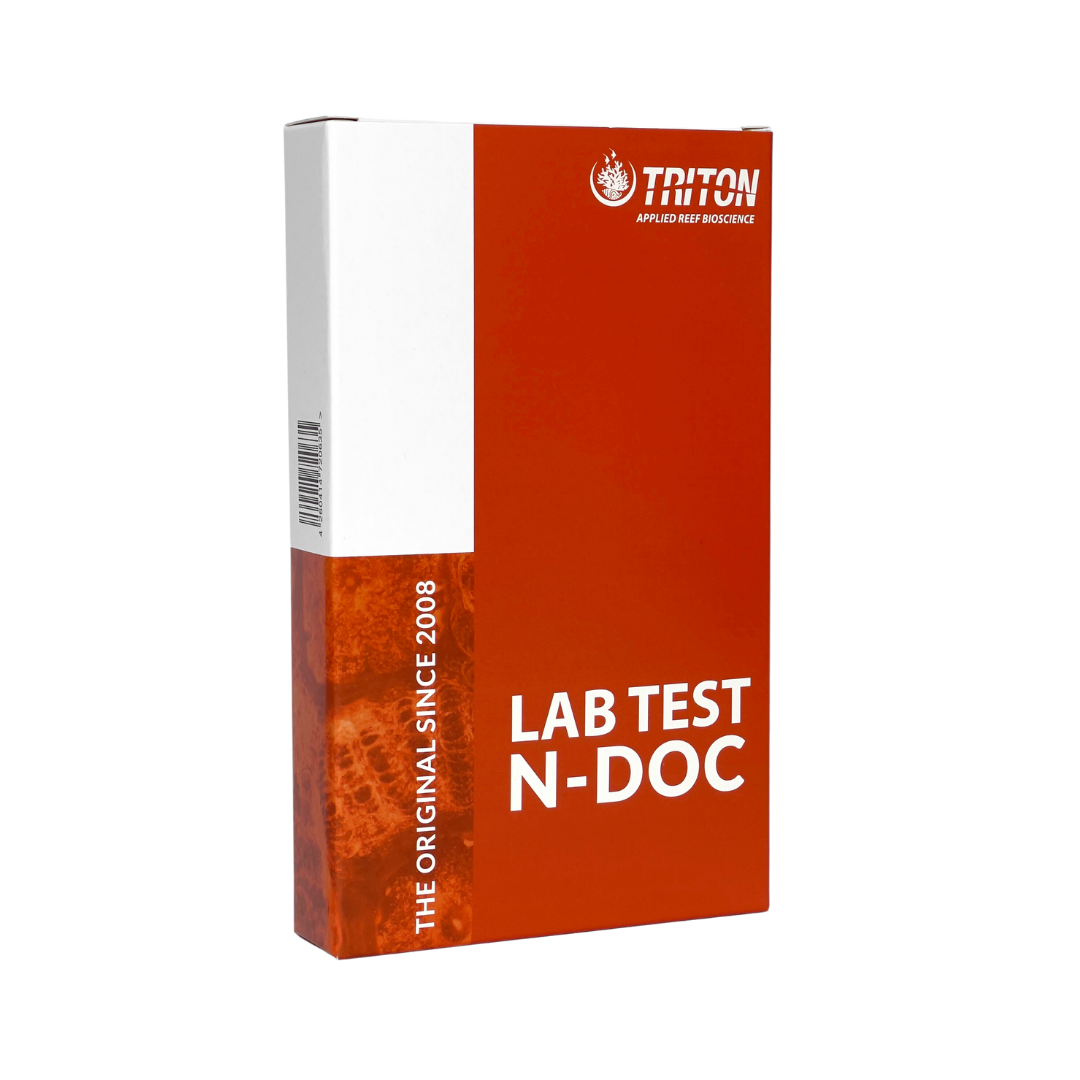
The missing part of your water analysis
What Your ICP Test Cannot See
Your ICP results show 41+ elements in perfect range. Calcium, magnesium, alkalinity — all green. But your corals are still losing colour, algae keep returning, and cyanobacteria appear without warning.
The problem is not in the elements. It is in the organic chemistry that ICP cannot measure — the carbon compounds, the nitrogen species, the organic chemistry that silently shapes your reef's health every day.
"ICP is essential for analyzing and assessing your water chemistry, but answering one question often leads to another. N-DOC becomes crucial when problems persist, even if the ICP results look fine."
— TRITON ACES SpecialistThree parameters. One complete organic profile.
What N-DOC Measures — TIC, TOC & TNb Explained
Each parameter reveals a different dimension of your reef's organic chemistry — invisible to any other test available for aquariums.
Total Inorganic Carbon — True Alkalinity
Your home test measures buffer capacity — how much acid your water can neutralise. TIC measures what you actually want to know: how much carbonate, bicarbonate, and dissolved CO₂ is in your system.
The difference matters. Substances like boron and organic carbon can distort at-home alkalinity readings. Based on our lab data, many customers discover their alkalinity has been off when they first run an N-DOC test — often by 0.5 to 1.0 dKH. If you've been targeting 7.5 dKH, your actual value may have been below 7.0 for years. Dropping below 6.0 dKH, or experiencing large fluctuations, can lead to multiple problems in a reef aquarium.
alk KH dKH
Total Organic Carbon — Everything Organic
Everything organic in your water — sugars, fats, amino acids, coral food residue, carbon dosing products. If you feed your corals or dose carbon, this is the number that tells you whether your tank can handle it.
If TOC rises above 3.5 mg/L, bacterial growth can accelerate — and not the kind you want. Harmful bacteria may outcompete beneficial ones, forming biofilms on surfaces and making it difficult for corals to thrive.
If elevated levels persist and bacteria begin uncontrolled growth in the water column, the resulting bloom can turn the water cloudy. Oxygen consumption may then increase so dramatically that animals effectively run out — with severe consequences.
DOC organics carbon dosing
Total Nitrogen Bound — Every Form of Nitrogen
Not just nitrate — TNb captures every nitrogen species in your water: ammonium, nitrite, nitrate, amino acids, and proteins. One measurement that reveals your complete nitrogen load.
Traditional nitrate tests only measure the end product of the nitrogen cycle — and nitrate is biologically active, meaning it changes during shipping. By the time your sample reaches the lab, the value may no longer reflect your tank. TNb solves this: it measures all bound nitrogen in a single, stable value. This is why TRITON complements the old nitrate measurement with TNb — more comprehensive, more reliable, and the foundation of the N:NO₃/N ratio that reveals whether your nitrogen cycle is healthy or heading toward trouble.
nitrate nitrogen NO₃
Based on 200,000+ analyses
The TRITON Ratios — A New Framework for Reef Chemistry
The Redfield Ratio (C:N:P = 106:16:1) was derived from open-ocean phytoplankton — not aquarium seawater. Applied to reef tanks, it delivers values more then 11 times off target
The TRITON Ratios replace it with a framework built from real aquarium data: 23,000 users, 200,000+ dual ICP/N-DOC analyses, contributions from public aquaria and research partners including Cairns Marine and years of dedicated research.
Four ratios describe the balance your reef needs — between nitrogen and nitrate, between nutrients and carbon, between inorganic and organic carbon. When these ratios shift out of range, problems follow: cyanobacteria, dinoflagellates, poor coral growth. N-DOC makes these ratios visible for the first time.
Total Nitrogen vs. Nitrate Nitrogen
Contrasts how much of your nitrogen is bound in nitrate versus other species. At a healthy 1 : 3 ratio, the nitrogen cycle is balanced. When the ratio shifts, it signals excess proteins, amino acids, or ammonium — and predicts cyanobacteria outbreaks before they become visible.
Nutrient–Carbon–Phosphate Balance
Replaces the Redfield Ratio for closed reef systems. Shows whether nitrogen, carbon, and phosphate are in the correct proportions for coral growth. Imbalance predicts algae and cyanobacteria outbreaks before they become visible.
Inorganic vs. Organic Carbon Balance
The ratio between inorganic carbon (TIC — your alkalinity system) and organic carbon (TOC — everything living organisms produce). When organic carbon rises relative to inorganic, your carbonate system comes under stress.
No other test in reef aquaristics provides these ratios. N-DOC combined with ICP is the only system that makes them calculable — one shipment, combined results, the complete organic and inorganic picture of your water.
Find Your Reef's Habitat TypeThe danger you cannot test at home
Why High TOC Kills Corals — Even When Your ICP Looks Perfect
Coral Food & Carbon Dosing
Food not digested by fish can quickly dissolve into organic carbon and nitrogen. Carbon dosing adds more. Both raise TOC — measurable only with N-DOC.
TOC Rises Above 3.5 mg/L
Organic carbon accumulates in the water column. Your ICP still looks perfect. Your corals are already under pressure you cannot see.
All Bacteria Multiply — Including Harmful Ones
High organic carbon feeds every species present in the tank — not just the beneficial ones. Harmful bacteria grow faster, outcompeting beneficial species for surfaces.
Coral Decline
Harmful bacteria can form biofilms on surfaces, damage coral tissue, and inhibit colonisation by beneficial bacteria. Corals may lose colour, stop growing, and eventually decline.
If elevated levels persist and bacteria begin uncontrolled growth in the water column, the resulting bloom can turn the water cloudy. Oxygen consumption may then increase so dramatically that animals can effectively run out of oxygen, potentially leading to fish loss — even in systems with otherwise perfect ICP results.
The Zooxanthellae Principle
Corals get up to 90% of their energy from zooxanthellae — the symbiotic microalgae inside their tissue, photosynthesising every day. Feeding corals is supplementary. When feeding becomes excessive, the organic load overwhelms the system before any ICP parameter shifts out of range.
The Seasonal Factor
Environmental organics enter your tank too. A small amount of pollen — dissolved in saltwater — can contain significant amounts of organic carbon and nitrogen equivalents. Seasonal spikes are real, measurable, and addressable — if you test for them.
For every reefer. At least once.
Who Needs an N-DOC Test — And When
Corals declining despite good ICP
Your ICP is clean, but corals are losing colour, fading, or showing RTN/STN. N-DOC reveals the organic imbalance that ICP cannot detect — the actual cause of the problem.
You dose carbon
Vodka, sugar, vinegar, bio pellets, commercial carbon sources — all raise TOC by design. Without N-DOC, you are dosing blind. N-DOC shows whether your carbon dosing is effective or accumulating to dangerous levels.
You feed your corals
Coral food is the most common cause of elevated TOC. N-DOC tells you whether your tank can process the organic load — or whether you are building up a problem that will surface months later.
Recurring algae, cyanobacteria, or dinos
The N:C:P ratio often predicts outbreaks before they become visible. If you experience recurring cyano or dinoflagellate problems, the organic imbalance driving them is measurable — and fixable — with N-DOC.
Starting a new tank
One N-DOC test at the beginning establishes your organic baseline. You cannot build a stable reef without knowing where your organic chemistry starts — especially if you inherit a tank or use second-hand equipment.
How often?
Do one test at the start. Once your organic parameters are in the green zone, a check every 6 months is enough — unless you change feeding practices, start carbon dosing, or experience new problems. The frequency mirrors ICP.
TRITON Organics — Supplements Based on Your N-DOC ResultsSame trusted workflow as ICP
How It Works — From Sample to Results
The N-DOC test follows the same process you know from ICP testing. Fill, ship, receive. Same lab infrastructure. Different instrument. Complete picture.
Order
Get your N-DOC test kit from an authorised TRITON dealer. Available as a standalone test or combined with ICP — one shipment, both analyses, combined results including TRITON Ratios.
Collect Your Sample
Fill the sample tube directly from your aquarium. Register the barcode online. Same process as ICP — takes two minutes. No equipment or chemistry knowledge required.
Ship to Our Lab
Send your sample to the nearest TRITON lab. When submitted within 7 days of an ICP test, the system automatically calculates your TRITON Ratios and delivers a combined organic + inorganic profile.
Receive Results
Your N-DOC analysis — TIC, TOC, TNb (Total Nitrogen), and TRITON Ratios — with specific product recommendations. Two separate instruments, two independent quality controls, one complete result.
The N-DOC test uses a TOC elemental analyser with proprietary TRITON modifications — developed and tested in-house for 2 years before launch. Available individually or as a combo with your ICP analysis. Price: equivalent to an ICP test. Two separate workflows, two independent quality controls — which is why we offer them individually. You choose what you need.
Elements + Organics = Full Visibility
N-DOC + ICP — The Complete Picture
What Is in Your Water
- 41+ inorganic elements
- Parts-per-billion precision
- Calcium, magnesium, trace metals
- Heavy metal contamination
- 500,000+ sample reference database
What Is Happening in Your Water
- TIC — true alkalinity (carbonate/bicarbonate)
- TOC — total organic carbon load
- TNb — total nitrogen (all species)
- TRITON Ratios (N:C:P, C/i:C/o)
No other lab offers both. No other system connects them. Together, ICP and N-DOC give you the only complete water analysis available in reef keeping.
Your questions answered.
Frequently Asked Questions
N-DOC is TRITON's organic compound test for reef aquariums — unique worldwide. It measures three parameters that ICP cannot: TIC (true alkalinity as actual carbonate content), TOC (total organic carbon from food, dosing, and biological processes), and TNb (total nitrogen bound — all nitrogen species including ammonium, nitrite, and nitrate). These organic parameters affect coral health as much as elements do. A perfect ICP means nothing if your organic chemistry is out of balance. N-DOC makes the invisible half of your water chemistry visible.
Carbon dosing — adding vodka, sugar, vinegar, or commercial carbon sources — feeds bacteria that consume nitrate and phosphate. It works, but without measurement, you are dosing blind. Too much carbon raises TOC, promotes harmful bacterial overgrowth, and can destabilise your reef. N-DOC is the only test that shows exactly how much organic carbon is in your water, so you can dose with precision instead of guesswork.
Home test kits and digital checkers measure alkalinity indirectly — they add acid until the pH drops, measuring buffer capacity. But buffer capacity is influenced by everything in your water: boron, organic carbon, phosphate, and other dissolved substances can distort the reading. N-DOC measures the actual carbonate and bicarbonate content directly. Based on our lab data, many customers discover their alkalinity has been off when they first run an N-DOC test — often by 0.5 to 1.0 dKH. If you've been targeting 7.5 dKH based on a home test, your actual value may have been below 7.0 for years. Dropping below 6.0 dKH, or experiencing large fluctuations, can lead to multiple problems in a reef aquarium.
Yes. ICP measures inorganic elements — calcium, magnesium, trace elements. But organic chemistry — carbon compounds, nitrogen species, bacterial activity — affects coral health just as much. High TOC promotes harmful bacteria. Imbalanced N:C:P ratios trigger algae and cyanobacteria outbreaks. These problems are invisible to ICP. N-DOC reveals them. As one of our specialists puts it: "ICP is essential for analyzing and assessing your water chemistry, but answering one question often leads to another. N-DOC becomes crucial when problems persist, even if the ICP results look fine."
Do at least one N-DOC test when you start, to establish your organic baseline and fix any issues. After that, a check every 6 months is sufficient for most reefers — as long as you maintain consistent feeding and dosing practices. Test more frequently if you change your feeding routine, start carbon dosing, introduce new livestock, or experience unexplained problems like algae or coral decline. In spring, environmental organics like pollen can increase the load, so an extra test during that season can help.
The most common cause is overfeeding — both fish food and coral food. Coral food that is not consumed by fish dissolves directly into organic carbon and nitrogen. Carbon dosing (vodka, sugar, bio pellets) adds organic carbon by design. Decomposing organic matter, environmental contaminants like pollen, and overstocking also contribute. N-DOC quantifies your TOC so you can identify the source and reduce it before it causes problems. The target: keep TOC below 3.5 mg/L.
ICP-OES analyses the inorganic elements in your water — 41+ parameters including calcium, magnesium, trace elements, and heavy metals. It uses optical emission spectrometry to measure concentrations at parts-per-billion precision. N-DOC analyses the organic chemistry — carbon compounds (TIC/TOC) and total nitrogen across all species (TNb). It uses a TOC elemental analyser. They measure completely different things using completely different instruments and workflows. Together, they provide the only complete water analysis available for reef aquariums. Available individually or as a combo test.
Live Every Sunday
Ask Ehsan DirectlyEvery Sunday, TRITON founder and CEO Ehsan Dashti answers your questions live — about reef chemistry, ICP results, and the TRITON Method. We announce each session with the exact time on our channels. Follow us so you never miss one.
The organic compound test for reef aquariums.
Your Reef Is Telling You Something.
ICP shows you the elements. N-DOC shows you what is happening — the organic chemistry, the carbon balance, the nitrogen species that drive coral health. Together, they give you the complete picture.