TRITON DIY Salt Mix Calculator
DIY Salt MixCalculator
TRITON DIY salts are pharmaceutical-grade compounds for precise manual adjustment of reef aquarium water chemistry. Enter your aquarium volume and current water parameters to calculate the exact grams of CaCl2, MgCl2, and NaHCO3 needed.
Calculate Your DIY Salt Dosage
Calcium, Magnesium & Alkalinity
Enter your aquarium volume once, then fill in the measured and target values for each parameter. The calculator shows the exact grams of each compound needed to reach your target concentration.
Aquarium Volume
Total system water volume including sumpCalcium — CaCl2
Calcium Chloride Dihydrate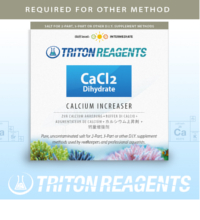 TRITON CaCl2
Current calcium in mg/l
Desired calcium in mg/l
Amount Required
—g
Increase calcium by no more than 20 mg/l per day. Spread larger corrections over multiple days.
Magnesium — MgCl2
Magnesium Chloride Hexahydrate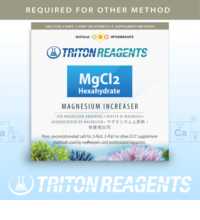 TRITON MgCl2
Current magnesium in mg/l
Desired magnesium in mg/l
Amount Required
—g
Increase magnesium by no more than 40 mg/l per day. Spread larger corrections over multiple days.
Alkalinity — NaHCO3
Sodium Bicarbonate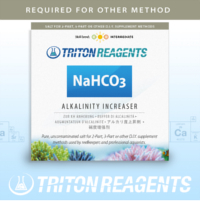 TRITON NaHCO3
Current alkalinity in dKH
Desired alkalinity in dKH
Amount Required
—g
Increase alkalinity by no more than 1 dKH per day. Spread larger corrections over multiple days.
"DIY salts give advanced reef keepers the precision to fine-tune individual parameters independently. When paired with regular ICP-OES testing, this approach delivers data-driven control over your water chemistry that no all-in-one product can match."
Ehsan Dashti, CEO of TRITON Applied Reef BioscienceWhy TRITON DIY Salts?
Pharmaceutical-Grade Precision
TRITON DIY salts are pharmaceutical-grade individual compounds that give reef keepers independent control over the three core water parameters: calcium, magnesium, and alkalinity. Unlike pre-mixed supplements, DIY salts let you adjust each parameter separately — essential when ICP-OES results show an imbalance in one element without the others.
Pharmaceutical-grade purity — No fillers, no binders, no unknown additives. Every gram contributes exactly the calculated amount of the target element.
Independent parameter control — Adjust calcium without affecting alkalinity. Raise magnesium without changing calcium. Precision that pre-mixed solutions cannot offer.
Cost-effective at scale — Available in 2,500 g containers, TRITON DIY salts are the most economical option for large aquariums or systems with high consumption rates.
ICP-OES verified — Pair DIY dosing with regular TRITON ICP-OES testing every 2–3 months to confirm your parameters are stable and within the optimal range for coral growth.
Practical Guidance
Getting the Most From DIY Salts
Preparing Stock Solutions
Dissolve each salt separately in RO/DI water. A common concentration is 100 g per litre of RO water for CaCl2 and MgCl2. For NaHCO3, use 70–80 g per litre as it saturates at a lower concentration.
Label each container clearly. Never mix different salts in the same stock solution — calcium and alkalinity solutions will precipitate if combined.
Dosing Best Practices
Dose into a high-flow area of your sump, not directly into the display tank. Add each solution at different times of day to prevent localised precipitation.
- CaCl2 and MgCl2 in the morning, NaHCO3 in the evening (or vice versa)
- Never exceed the daily maximums shown in the calculator
Target Values & Testing
Natural seawater reference: Calcium 420 mg/l, Magnesium 1,320 mg/l, Alkalinity 6–7 dKH. Most reef aquariums run well at Ca 420–450, Mg 1,320–1,380, KH 7–9.
Stability matters more than exact numbers. Avoid large daily swings. Confirm your levels with a TRITON ICP-OES analysis every 2–3 months.
Common Questions
Frequently Asked Questions
TRITON DIY salts are pharmaceutical-grade individual compounds — Calcium Chloride Dihydrate (CaCl2·2H2O), Magnesium Chloride Hexahydrate (MgCl2·6H2O), and Sodium Bicarbonate (NaHCO3). You dissolve them in RO/DI water to create concentrated stock solutions, then dose the calculated amount to raise specific water parameters in your reef aquarium. This gives you precise, independent control over calcium, magnesium, and alkalinity.
TRITON recommends increasing calcium by no more than 20 mg/l per day, magnesium by no more than 40 mg/l per day, and alkalinity by no more than 1 dKH per day. Exceeding these limits can stress corals and cause precipitation of calcium carbonate. If your parameters are far from the target, spread the correction over multiple days.
The most accurate way is a TRITON ICP-OES water analysis, which measures 45 water parameters at parts-per-billion precision — but not alkalinity. Use a reliable dKH test kit for alkalinity, and add a TRITON N-DOC test every 6 months to confirm organic loading. For routine monitoring between ICP tests, standard calcium and magnesium titration kits suffice. Always use the measured values — not estimates — when entering data into the calculator.
Natural seawater reference: Calcium 420 mg/l, Magnesium 1,320 mg/l, Alkalinity 6–7 dKH. Most reef aquariums run well at Ca 420–450, Mg 1,320–1,380, KH 7–9. Stability matters more than exact numbers. Avoid large daily swings. Confirm your levels with a TRITON ICP-OES analysis every 2–3 months.
This calculator outputs the amount of dry compound in grams. If you dose from pre-mixed stock solutions, you need to know the concentration of your solution to convert grams to millilitres. For example, a common CaCl2 stock solution is 100 g dissolved in 1 litre of RO water — so if the calculator says 3 grams, you would dose 30 ml of that solution.
Precision Starts With Data
A TRITON ICP-OES analysis measures 45 water parameters at parts-per-billion precision. Use it to verify your DIY salt dosing is on track — or to discover parameter imbalances that hobby-grade test kits miss.